
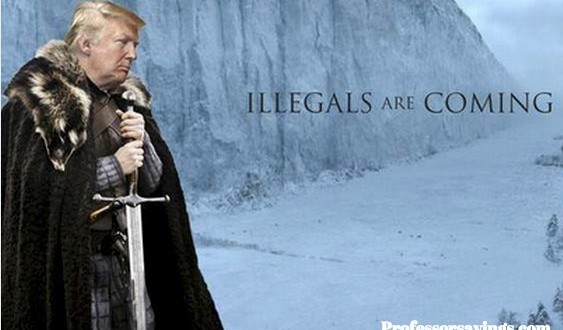
With apologies to Game of Thrones addicts (I personally don’t over-imbibe), success in politics has historically relied upon barbarian despotic leader dark triad like attributes such as bribery, intimidation, assassination, corruption, and big time power-wielding often reflected in ones ability to use special access, back room influence, connections, and leverage among others who hold substantial power and authority. LBJ is a good example of an “old school” politician…and that might even include the assassination part. My sons tells me one of their favorite TV series Game of Thrones (GOT) similarly gets “down and dirty” as far as backstabbing, collusion, betrayal and the proverbial “heads will roll” approach to becoming the ultimate “top dog”.
For many reasons this formula has changed somewhat over time to one that depends more on the use of ones personal charisma, likability, and ability to connect (ie.,reciprocal projection) with the largest base of voters possible. This would now also include voters with “grassroots” as well as old school “power broker” ties. While ambition and extraordinary drive have always been positive factors, winning a presidential election today requires someone with endless ambition, remarkable energy and a mental/emotional manufacturing plant of money, unabashed ego and supreme self confidence operating 24/7. Based on the above, Donald Trump exhibits all the “right stuff” whether you like him or not. Hillary Clinton, on the other hand, while well suited to the actual on-the-job requirements for POTUS, stumbled badly by choosing to not see or address certain polling related bad omens early on and refusing to listen to related warnings shared with her by her philandering consort/quasi-hubby/former President Bill Clinton…a pretty sharp and charismatic political player himself. As a result, she was outplayed on the last major presidential campaign battlefield.
I am suggesting that Donald Trump who is often seen as an unusually vain village idiot very well may have various Julius Caesar like attributes that Hillary lacks.
In Game of Thrones vernacular, you don’t need a Valyrian steel sword if you’ve got Julius Caesar’s “tiger blood” DNA. Sad but true.
Read below two separate psychobiographical summaries of the unlikely Emperor Julius Caesar and note the specific ways (like it or not) that Donald Trump holds a much closer resemblance than wonky intellectually gifted Hillary Clinton. Even the Republican establishment didn’t see THAT coming.
Analysis #1: Traits/Qualities Julius Caesar Possessed that Led to His Remarkable Success
Street Smart Intelligent and Self-Confident
First and foremost, Julius Caesar, the Roman general and statesman who upended the Republic and it’s laws, was a smarty pants unto himself, especially in military strategy. His supreme self-confidence, bordering on delusional narcissism was an important reasons why he was so successful. Caesar was a compelling speaker when he needed to be. When he was addressing the Senate or the public, Romans hung on his every word. His critical and decisive mind was especially beneficial during his military career. He specifically planned and strategized to outmaneuver his opponents. Essentially, like Trump he didn’t care about the “poll numbers”.
Julius Caesar: Endlessly Energetic
In addition to being clever, Caesar was incredibly energetic. As the governor of Gaul, Caesar was able to fight wars for seven years while also writing a series of books recounting his many escapades. During his life, Caesar traveled non-stop. Whether he was fighting a war or simply visiting a Roman province, he was constantly on the move and seemed to need little sleep.
Caesar’s energy was also evidenced in his romantic exploits. Over the course of his life, he had three wives and multiple mistresses. Imagine taking over a country, fighting multiple wars, AND juggling several girlfriends at the same time. The man never tired! Sound familiar?
Julius Caesar: Cunning Yet Generous
Immense military intelligence and energy were not the only qualities that made Caesar a formidable leader. He was also exceptionally driven, power-hungry, and cunning. Caesar came from a noble but relatively poor family. What Caesar lacked in funds he made up for with an insatiable thirst for power. Every action was calculated for personal gain; nothing he did was without purpose personally.
For example, when one of his greatest political opponents died, Caesar went out of his way to memorialize the man. Later Caesar acknowledged this was done not because he liked him or thought he was a great guy but because Caesar knew that speaking well about his fallen adversary would help neutralize his opponents posthumous influence.
Aside from being cunning, Caesar was also exceedingly generous, bestowing lavish gifts on the people closest to him. He gave his mistress, Cleopatra, her own palace in Rome. Additionally, he showed unusual mercy to the people he conquered and spared many of the political opponents he defeated. Sound somewhat familiar?
Analysis#2: Julius Caesar: Personality Type Analysis
Caesar.jpg
Gaius Julius Caesar was a Roman aristocrat, politician, military leader, Dictator, and author, active in the last decades of the Roman Republic, in the first century BC. His impact on western history is enormous: he was chiefly responsible for incorporating Gaul (i.e. modern France) into the Mediterranean world i.e. the Roman Empire, as well as indirectly for the same with regards to Britain. The modern calendar, based on a year of 365 days with a leap year every 4 years, and 12 months, is essentially the same one as introduced under his instructions. The month ‘July’ was named so in his honour, after his clan name ‘Julius’, immediately after his death. His family name, ‘Caesar’, eventually became a synonym for ’emperor’, surviving into the 20th century as ‘Kaiser’ and ‘Tsar’. He is also generally regarded as one of history’s greatest military leaders, his battles serving as case studies to this day.
Although by ancestry belonging to the high nobility – Caesar’s family was (relatively) impoverished by the time he was born in 100 BC. In the ultra-competitive, expensive, high-stakes world of Roman politics of his time, that meant that Caesar, not withstanding his titled family background had to adopt unconventional means of advancing his political career from an early age.
Especially considering his circumstances and powerful opponents, Caesar’s political career was extraordinarily successful, with him advancing faster, and to much greater heights than any of his contemporaries, even those far wealthier and better connected.
Simplistically put, Caesar’s whole career progressed on the basis of all-or-nothing extreme risk-taking. In electoral politics, that meant spending money far beyond his means, getting into debt to the point of criminal liability – but always rescued later by electoral or military success. Failure at any point could have meant bankruptcy, disgrace, and exile: famously, at the age of 37, he bet it all in winning the election to Pontifex Maximus, telling his mother that day that either he’d win or have to go into exile. Once again sound a little familiar?
Likewise, as a military leader, his style was to get himself and his men into very difficult situations (numerical inferiority, poor logistics, unknown and hostile territory, etc.) and then use tactical brilliance and in-the-moment improvisation to find a way out – always with supreme self-confidence in his own abilities and, as he himself put it, “Caesar’s luck”. In so doing, he re-invented ancient warfare as he went along, even in situations where he had no previous experience, as in siege warfare (Alesia) or urban warfare (Alexandria) or in more conventional battles (Pharsalus). This meant that more conventional or cautious commanders such as Pompey were outmaneuvered by Caesar even when they held in numerical and tactical advantage.
Caesar obviously trusted his in-the-moment tactical improvisation and often neglected the accumulation of available military intelligence, as in his first expedition to Britain. That almost led to disaster as he simply did not realize that the Channel tides were far more intense than those of the Mediterranean. Trump much?
Caesar’s never-ending, sometimes even reckless pursuit of political power, as well as his natural ability to lead (along with his confidence in his own assessment of the likely outcome on the battlefield) demonstrate a “fearlessness” that few possess. This is also confirmed by his apparent lack of physical fear even in very disadvantageous situations, such as when he was kept prisoner by pirates (he mocked them and said he’d crucify them as soon as he was set free…which he did). Talk about a penchant for “get back”. “Revenge is sweet” could have been his middle name.
As a leader of men, Caesar was notorious for not caring about imposing discipline on his men in the way of protocol and accepted rules: what he cared about was their loyalty, obedience, competence. and trust (i.e. willingness to follow him into seemingly hopeless situations). His leadership was based not mainly on the fact that he was their hierarchical and social superior, but that he was “trusted” to be better than they were at being the principal leader and therefore deserved to be followed. Alexander the Great may be his only historical peer in this respect.
Caesar’s extreme confidence can be seen in his own memoirs of his conquest of Gaul, when he repeatedly boasts of his personal relationship to the Gallic chieftains (and complains of those who couldn’t be trusted). It can also be seen in his approach to political enemies: Caesar was so confident in his ability to gain the trust of those he had defeated that he preferred to pardon them and receive them as friends once they were vanquished. Now it’s getting almost scary as far as Trump comparisons are concerned!
Caesar’s pursuit of personal political power and wealth, besides based on extreme risk-taking, was also based on ignoring accepted societal conventions and rules, even laws. His approach was to achieve his goals, regardless of their difficulty and worry less about such “details”. The problem with that is that his continuous illegalities led to him being liable to prosecution by his many political enemies. Like his near-disastrous self-imposed military traps, that was a longer-term personal trap that he allowed himself into (arguably without realizing it) leaving him no way out except through his ultimate extreme gambles i.e. illegally invading Italy proper with his legions, characteristically saying “let the dice fly” as he did so.
Having achieved (illegal) control of Rome and Italy through sheer military power, Caesar was concerned about legalizing it but he did so in a seemingly ad hoc manner, becoming at first Dictator for just a few days, then consul, then later Dictator again in different ways – as with military campaigns, all done in a ‘making it up as you go along manner’ and apparently having less concern with legal precedent or consistency. By now the Trump comparisons probably make you think I’m making this shit up. Im not. Look it up.
Although chiefly concerned with completing his victory over his political enemies, during his period as Dictator, Caesar engaged into a series of isolated reforms: a settlement of the debts of over-indebted individuals, urban reform in Rome, reform of the then-chaotic calendar (introducing the modern calendar), reform of the supply of subsidized grain, etc. All of those were implemented with enormous energy in a very brief period of time, but rather as a series of isolated measures aimed at fixing specific economic problems pragmatically, not as part of any ‘restructuring’ of Roman society or constitution. Indeed, despite his own position having become essentially extra-constitutional, Caesar showed no apparent interest (or idea) of how to adjust the Roman constitution accordingly, and at the time of his death his plan was to start another huge military campaign, against Parthia (Persia). This shows where his true priorities lay.
Conclusion: Julius Caesar was a man most focused and able, and an ultra confident individual, particularly in matters of career climbing, military exploits and eventual conquest (winning). Almost always he succeeded in an unorthodox way where extreme (and sometimes almost disastrous) risk-taking was the pattern, and with little sign of longterm strategy or overarching vision. In fact, in most matters he appeared to lack any visible ‘ideology’ (except that of his own rising to the top).
Finally, besides being supremely confident in his ability to get the respect and trust of key individuals, by all accounts he was the “perfect politician” in terms of knowing the value of self propaganda and in exercising enormous personal charm, especially when he wanted to and/or needed to.
There you have it. Game of Thrones much? Only in the real world there are no dragons, elves or clever dwarves like Tyrion Lannister to bring much needed balance, fairness, negotiation, humor or even a humane perspective to a vicious dog eat dog world.

 captaincliff